Discover Diamonds

The Four Cs

Cut, colour, clarity and carat, set out in the order they actually change how a diamond looks.

Three of the four were decided underground. One was decided by a person.

Colour, clarity and weight are properties the stone arrived with. Cut is the only one a human chose, and it is the one that determines whether a diamond returns light or holds on to it. A stone graded highly on the other three and cut carelessly will look flat next to a well-cut stone two grades below it.
So we read a certificate from the bottom up, and we look at the stone before we read anything at all.

I

Cut

The only one of the four decided by a person, and the one that decides whether a stone looks alive.
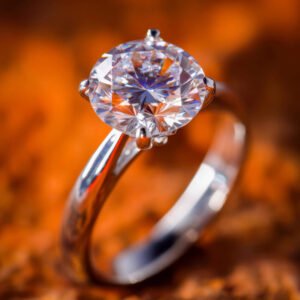
Cut describes proportion, symmetry and polish: how faithfully the cutter followed the angles that send light back out through the table rather than leaking it through the sides. A stone cut for weight instead of beauty keeps more carats and loses its brilliance.
What we advise
Do not go below Very Good, and pay the premium for Excellent before you spend anything on colour or clarity. On fancy shapes, where no standard cut grade exists, judge the stone by eye against its alternatives.
Cut grades, round brilliant

Excellent

Where we buy

Very Good

Acceptable

Good

Visibly duller

Fair

We decline

Poor

We decline
Fancy shapes are not given an overall cut grade. They are assessed on proportion and symmetry instead, which is why seeing them matters more.

II

Colour

Graded from colourless down towards a faint warmth, in steps most people cannot see unaided.
The scale runs D to Z. Neighbouring grades are nearly indistinguishable face-up, particularly once a stone is set, and the metal around it shifts the perception further: white metal shows warmth, yellow and rose gold absorb it.
What we advise
In platinum or white gold, G to H gives a colourless appearance for considerably less than D. In yellow or rose gold, J to K sits beautifully and the saving is better spent on cut.

Colour grades, D to Z

D E F

Colourless

G H I

Near colourless

J K

Warm in white metal

L to Z

Visible tint
Larger stones show colour more readily than small ones, so we move up a grade or two as weight increases.

III

Clarity

The inclusions the stone grew with. What matters is whether you can see them, not what the report says.
Inclusions are natural features formed as the crystal grew, described by size, number and position. A stone graded VS2 with an inclusion under the table can look cleaner than an SI1 with one beside the girdle.
What we advise
Buy eye-clean rather than buying a grade. VS2 to SI1 is where most of our clients find the best value, and we check every stone with the naked eye at arm’s length before we offer it. Step cuts need one grade higher, as their open facets hide nothing.
Cut grades, round brilliant

FL IF

Flawless

VVS1 VVS2

Very hard to find

VS1 VS2

Eye-clean

SI1 SI2

Often eye-clean

I1 to I3

Visible
Flawless stones command a premium for rarity rather than for appearance. Very few people can identify one without a loupe.

IV

Carat

Weight, not size. Two stones of equal weight can look quite different on the hand.
A carat is a fifth of a gram. Where that weight sits decides how large the stone reads: a deep stone hides its weight below the setting, while a well-proportioned or elongated stone spreads it across the face.
What we advise
Buy just under the round numbers. A 0.90ct sits a noticeable step below 1.00ct in price and a fraction of a millimetre below it in width. Elongated shapes read larger for the same weight.
Weight and spread

0.50ct

about 5.1mm

0.90ct

about 6.2mm

1.00ct

about 6.5mm

1.50ct

about 7.4mm

2.00ct

about 8.2mm
Approximate face-up width for a well-cut round brilliant. Spread varies with proportion, so treat these as a guide rather than a promise.
In Practice

Where we would spend the budget

If the budget is fixed

Cut, then size

Hold Excellent cut, drop colour to G or H and clarity to VS2 or SI1, and put everything you save into the stone’s spread. The result looks larger and brighter than the grades suggest.
If it is an heirloom

Buy the rarity

Where the piece is meant to be handed on, higher colour and clarity hold their meaning and their market. We would still not compromise the cut to reach them.
If you are unsure

Come and look

Bring two or three candidates and we will show them side by side in the same light. Almost everybody changes their mind at least once, and it costs nothing to do it before the piece is made.

Have a certificate you would like read?

Send it over and a specialist will tell you what it means for how the stone will look, in plain terms.